
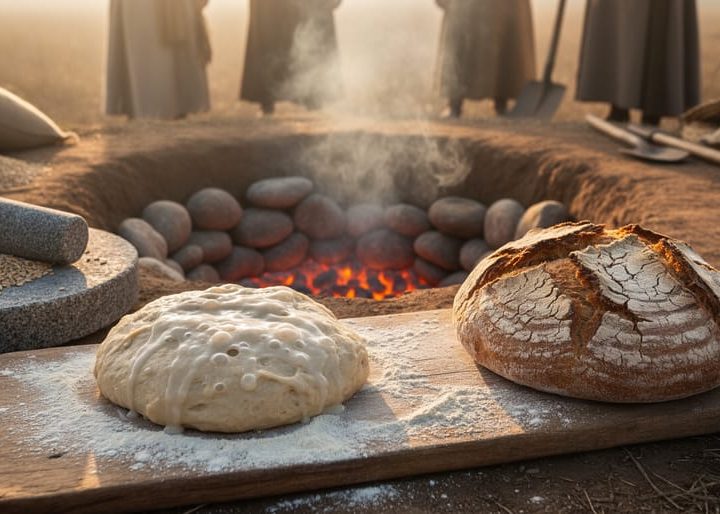
Baking began more than 14,000 years ago when ancient peoples discovered that grinding wild grains into flour and mixing it with water created a dough that, when heated on hot stones, transformed into something nourishing and delicious. This accident of experimentation became one of humanity’s most important culinary breakthroughs, shaping civilizations and bringing people together around shared meals for millennia.
I’ve always been fascinated by how the simple act of mixing flour, water, and heat connects us to countless generations of bakers who came before us. Every time I pull a loaf of bread from my oven in 2026, I’m participating in a tradition that stretches back through Egyptian bakeries, medieval guilds, and my own grandmother’s kitchen. The tools have changed, sure, but the magic of transformation remains exactly the same.
The story of baking’s origins isn’t just about ancient history. Understanding where our favorite techniques came from actually makes us better bakers today. When you know that sourdough starters were born from wild yeasts in the Fertile Crescent, or that pie crusts evolved from medieval coffyns (protective cases for cooking meat), you start to see patterns in how ingredients behave. You realize that the crusty exterior of artisan bread isn’t a modern invention but something bakers have been perfecting for thousands of years.
What started as flatbreads cooked on rocks eventually gave us leavened loaves, pastries, cakes, and every baked good we treasure now. That journey from stone to oven tells us something profound about human creativity and our endless desire to make food that brings joy.
When Humans First Started Baking
Our baking journey starts much earlier than you might think. Long before anyone dreamed of fluffy cakes or buttery croissants, our ancestors were already transforming simple grains into something edible and nourishing. The Stone Age flatbread evidence shows that humans began baking around 30,000 years ago, grinding wild grains between stones and mixing the resulting powder with water to create a paste that could be cooked over hot rocks.
These early flatbreads weren’t much to look at. They were dense, chewy, and probably tasted pretty bland compared to what we consider bread today. But they represented a huge leap forward for humanity. Someone figured out that grinding grain, adding water, and applying heat created something portable, shelf-stable (at least more so than raw grain), and filling. That basic formula still forms the foundation of nearly everything we bake.
What strikes me most about these ancient bakers is how they worked with what they had. No thermometers, no measuring cups, no timers. They learned through experience when the grain was ground fine enough, how much water to add, and when the flatbread was cooked through. They developed an intuition for the process that we’re actually trying to reclaim today when we talk about becoming more confident bakers.
The transition from accidental grain cakes to intentional baking happened gradually. As humans settled into agricultural communities and began cultivating grain crops around 10,000 years ago, baking became more refined. They experimented with different grains, discovered that certain mixtures produced better textures, and learned that grinding techniques affected the final product. These weren’t just survival skills anymore; they were the beginning of baking as both craft and science.
Ancient Civilizations That Shaped Baking
The Egyptians: Masters of Leavened Bread
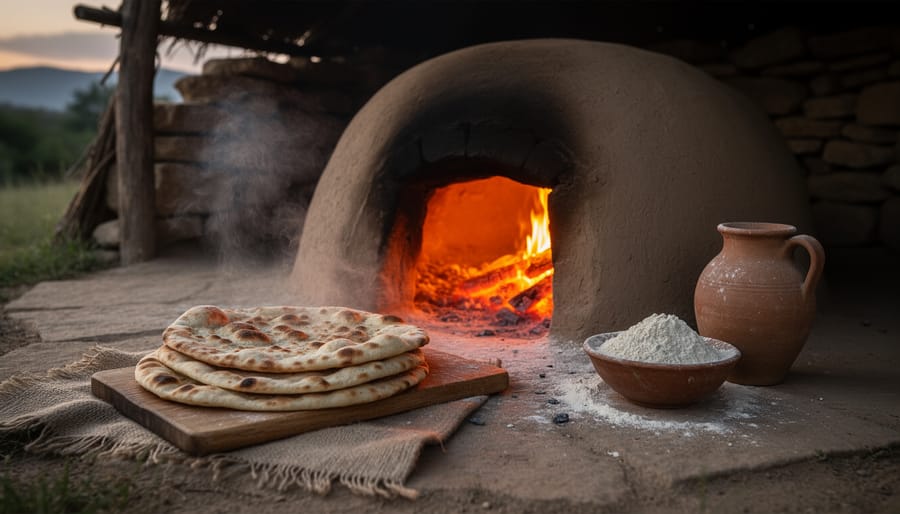
The Egyptians turned baking from a basic survival skill into an art form around 3000 BCE. They stumbled onto something magical when they left a grain-and-water mixture out too long. Wild yeast from the air got in, and the dough bubbled and rose. That first puffy loaf must have seemed like pure magic.
I think about those ancient Egyptian bakers every time I feed my sourdough starter. They didn’t understand the science behind fermentation, but they learned to control it through trial and error. Egyptian leavened bread evidence shows they developed over fifty varieties of bread, experimenting with different grains, shapes, and fermentation times.
What strikes me most is how little the fundamentals have changed. The Egyptians discovered that patience makes better bread. They learned that a portion of yesterday’s dough could start today’s batch (hello, sourdough starter). They figured out that warmer spots sped up rising while cooler areas slowed it down.
When I’m waiting for my dough to double in size, I’m using the same observation skills those Egyptian bakers relied on thousands of years ago. They couldn’t set timers or check temperatures with thermometers. They watched, touched, smelled, and tasted. That hands-on intuition is something we can still learn from, even with our modern kitchens and instant yeast packets sitting in the fridge.
The Romans: Professional Bakers and Public Ovens
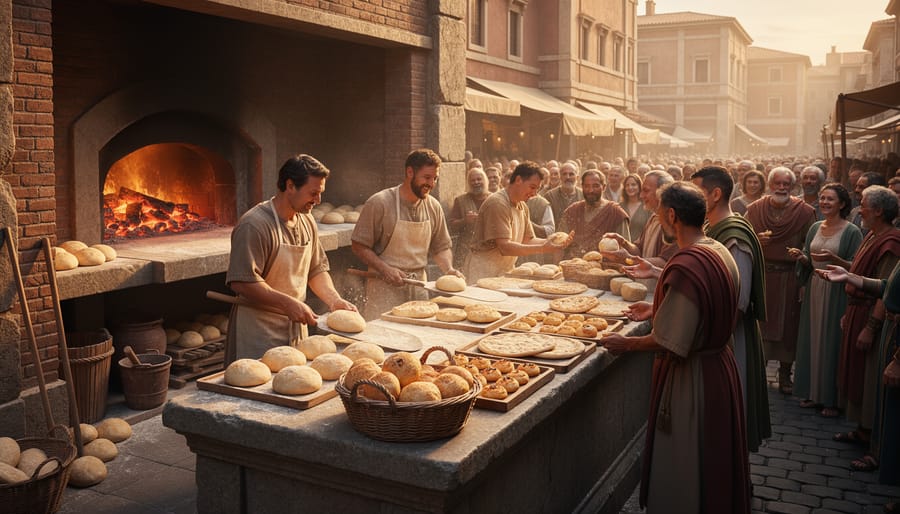
The Romans transformed baking from a household task into a respected trade. By the second century BC, Rome had professional bakeries scattered throughout the city, each equipped with dome-shaped ovens that could reach much higher temperatures than anything the Egyptians had built. Professional bakers in Rome formed a guild called the Collegium Pistorum around 168 BC, giving them legal status and establishing quality standards that protected consumers from inferior bread.
These specialized ovens changed what was possible in baking. Romans developed the first pastries using thin layers of dough brushed with oil, creating treats that resembled modern phyllo-based desserts. They sweetened their baked goods with honey and studded them with nuts and dried fruits. The wealthy could order elaborate breads shaped into spirals, braids, or even sculptural forms.
When I made the leap from casual weekend baker to creating Christy’s Baking Origins, I felt a kinship with those early Roman professionals. They took something essential and made it special through dedication and skill. Their innovation reminds me that every time we perfect a technique or try a new recipe, we’re part of that same tradition of turning simple ingredients into something remarkable.
Medieval Europe: The Rise of Guild Bakers
Medieval bakers didn’t just make bread, they created the first quality standards we still use today. By the 1200s, European cities required bakers to join guilds that controlled everything from flour weights to oven temperatures. Break the rules? You’d face public punishment or lose your livelihood.
These guilds separated bakers into distinct groups. White bread makers served wealthy nobles with fine wheat loaves. Brown bread bakers used coarser grains for commoners. Pastry makers formed their own elite guild, guarding recipes for elaborate pies and sweet confections. This specialization pushed baking far beyond basic survival food.
Guild regulations forced bakers to mark every loaf with their personal stamp. If a customer got cheated with a light loaf or poor ingredients, everyone knew exactly who to blame. That accountability shaped how we think about baking quality today.
I love that medieval bakers passed knowledge through strict apprenticeships lasting seven years. No shortcuts, just hands learning the craft properly. When I struggled perfecting my sourdough, I thought about those apprentices working daily beside masters. Some techniques can’t be rushed, and that patient approach to learning still matters in our modern kitchens.
How Baking Tools Evolved Over Time
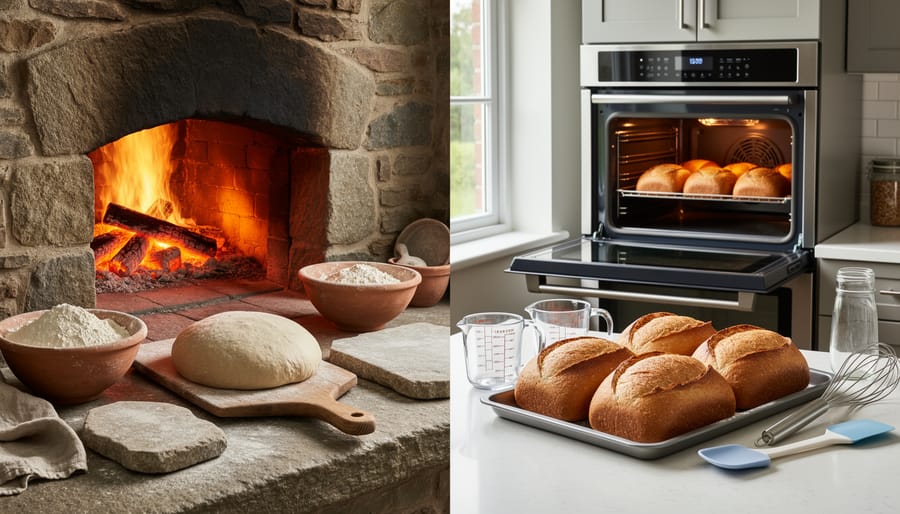
The journey from hot stones to sleek stand mixers tells us more about baking’s resilience than its transformation. When our ancestors first baked, they used whatever nature provided: flat rocks heated in fire, hollowed-out logs for mixing, and their bare hands for kneading. What strikes me most is how these primitive tools established principles we still follow today, controlled heat, thorough mixing, and proper dough handling.
| Ancient Tool | Modern Equivalent | Core Principle |
|---|---|---|
| Hot stones | Baking sheets and pizza stones | Even heat distribution from below |
| Clay ovens (tannurs) | Dutch ovens and steam-injected ovens | Heat retention and moisture control |
| Wooden bowls and hands | Stand mixers with dough hooks | Developing gluten through mechanical action |
| Sifting baskets | Fine-mesh sieves | Removing impurities and aerating flour |
The Egyptians developed the first true ovens, domed clay structures that could trap and circulate heat. These early ovens worked on the same convection principle as your kitchen oven, just without the thermostat. Romans later added metal doors and flues for better temperature control, innovations that remained standard for nearly two thousand years.
Measuring tools evolved more slowly than you might expect. Volume measurements came first, a handful, a cup, a bowl, and weight-based precision didn’t become common until the 1800s. This explains why many traditional recipes still feel imprecise by modern standards. Bakers learned to judge by texture and appearance rather than exact measurements, a skill that makes you more adaptable in the kitchen even today.
The real revolution came with temperature control. For millennia, bakers tested oven heat by holding their hand inside or tossing in flour to see how quickly it browned. The first oven thermometers appeared in the early 1900s, finally giving home bakers the precision that professionals had achieved through years of experience. This single advancement democratized baking more than any other tool, letting beginners achieve consistent results their first time.
What fascinates me is how little the fundamentals have changed. Whether you are kneading dough on marble or in a mixer, the goal remains identical: developing gluten structure. Your electric oven may heat more evenly than a wood-fired one, but both work by surrounding food with hot air. The tools got easier to use, but the underlying chemistry stayed exactly the same.
The Ingredients That Changed Everything
Standing in my kitchen today, I’m surrounded by ingredients our ancestors would have considered impossibly luxurious. That jar of white sugar, the stick of butter in my fridge, the packet of instant yeast, each represents a revolution in baking history.
For thousands of years, bakers worked with just a handful of basics: coarse ground grains, water, and whatever fat or sweetener they could find locally. Honey was precious, butter was a luxury only the wealthy enjoyed regularly, and refined white flour simply didn’t exist. Most people ate dense, dark breads made from whatever grain grew in their region.
Sugar changed everything first. When European trade routes opened in the Middle Ages, sugar transformed from medicine to ingredient. Suddenly, bakers could create sweetness without relying on seasonal honey or dried fruits. This single ingredient birthed entire categories of baked goods, cookies, cakes, and pastries as we know them became possible.
The refinement of flour in the 18th and 19th centuries was equally transformative. Ancient bakers ground whole grains between stones, producing flour that would seem impossibly coarse to us now. When industrial milling created consistently fine, white flour, bakers could finally achieve the light, delicate textures we take for granted in layer cakes and tender biscuits.
Then came reliable leavening agents. While our Egyptian ancestors stumbled onto fermentation, we can buy standardized yeast or chemical leaveners that work predictably every time. Baking powder, invented in the 1840s, meant you didn’t need to maintain a sourdough starter or wait for natural fermentation.
Here’s what strikes me most: these ingredients didn’t just expand what bakers could make, they democratized baking itself. When I pull out refined flour, sugar, and baking powder to make a simple cake, I’m using ingredients that would have seemed magical to bakers just 200 years ago. Understanding this history makes me grateful every time I preheat my oven.
What Ancient Baking Teaches Us Today
Studying ancient baking has completely changed how I approach my own kitchen work. When I learned that Egyptian bakers let dough ferment naturally because they had no choice, I realized patience wasn’t a modern virtue, it was a survival skill that created better bread. Those bakers couldn’t rush to the store for instant yeast, so they learned to work with natural fermentation cycles. That same principle applies when I’m making sourdough today: the dough tells me when it’s ready, not the timer.
The hands-on techniques our ancestors used haven’t lost their relevance just because we have stand mixers. When I knead dough by hand occasionally, I understand its development in a way no machine can teach me. I feel when gluten forms, notice when more flour is needed, and catch problems before they become disasters. Medieval bakers didn’t have thermometers, so they learned to recognize proper oven temperature by sight and smell. I’ve started doing the same, even though I own three thermometers, and it’s made me more confident when equipment fails.
Ancient baking also reminds me that simple ingredients can create extraordinary results. Roman bakers made remarkable breads with just flour, water, salt, and natural fermentation. That lesson keeps me from obsessing over specialty ingredients when foundational technique matters more. Understanding where baking comes from has taught me to trust the process, respect the ingredients, and remember that every baker throughout history faced the same fundamental challenges we do today.
Every time I pull a loaf from my oven, I’m connected to thousands of years of bakers who did the same thing with far less. That Egyptian baker who accidentally discovered fermentation, the Roman professional perfecting their craft in public ovens, the medieval guild member maintaining standards, they’re all part of why we bake the way we do today.
Understanding the origins of baking has fundamentally changed how I approach my own kitchen. When I’m kneading dough, I’m not just following a recipe, I’m participating in humanity’s oldest culinary tradition. Those ancient techniques we explored? They still work because the chemistry of flour, water, and heat hasn’t changed.
You don’t need fancy equipment or exotic ingredients to connect with baking’s rich history. Start with a simple loaf using just flour, water, salt, and time. Feel the dough transform under your hands the way it has for millennia. That’s where the real magic lives.
I created Christy’s Baking Origins to share this journey with you, to explore not just how we bake, but why it matters. Because when you understand where baking comes from, every cookie becomes more meaningful and every bread more satisfying. Let’s keep discovering together, one delicious batch at a time.